Automatism Unleashes New Ideas

I have always loved the work of Max Ernst and wondered how he created the beautiful textures in his paintings. Seeing his work at the Surrealism and Magic show in the Peggy Guggenheim Museum in 2022 took my breath away. I learned that he painted canvas with oil paint, covered it with cellophane or something else, then pulled the cellophane off to create the textures. This process is called decalcomania.

The Guggenheim show was part of the 2022 Venice Biennale’s exhibition titled the Milk of Dreams, from the title of a book by Leonora Carrington. She along with other women Surrealists including Remedios Varo, Dorthea Tanning and Leonor Fini were among the artists shown. Unfortunately, women were rarely mentioned in my art history classes, so I loved learning more about these extraordinary artists. Only recently have they begun to receive  credit for their contribution to Surrealism.

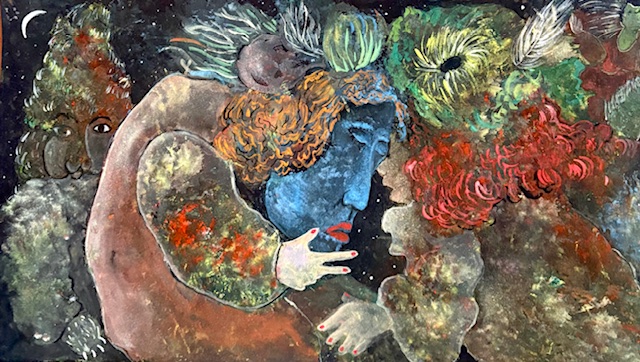
I’ve always played with automatic drawing by finding images in scribbles. Since seeing the Surrealism exhibit, I have been experimenting with other automatism techniques the Surrealists used. Recently, I had so much fun making a small sponge painting, I decided to go big. Covering a large sheet of black paper with blobs of paint, I embellished images I saw. More and more arose. As a side effect, new ideas have found their way onto my possible paintings list.


.
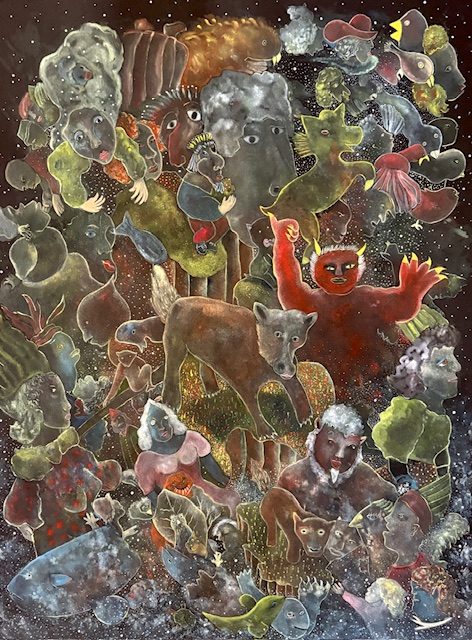
It seems I have a bad case of pareidolia, the tendency to see faces in everything. My kitchen appliances smile. Animals and faces appear in wood floors. Strange beings look up from the loops of my bathmat. Since working on the large sponge painting, I’m seeing faces everywhere. Pareidolia has been triggered big time.

Psychiatrists used to say that pareidolia is a mental illness. Thank goodness it’s now seen as normal. Paul Klee, one of my favorite artists, had pareidolia, as well as a number of other artists. Similarly, Leonardo Da Vinci had apophenia, the tendency to see connections between unrelated things. He looked at stains on walls to get inspirations for landscapes. I’ve got some of that, too. When I’m flying, the drone of jet engines turns into choral music.

Surrealists believed that using automatism techniques is a way to connect to the unconscious. Is that where the beings in my painting come from? As a seeker of connection to the greater reality, I have added playing with automatism techniques to my practice of dreamwork. You might find that experimenting with these techniques takes you to a dreamy state where new ideas arise.


Artist Play Date

Most artists find themselves stuck at times. Thankfully, I’ve found a method that helps me when I’m in that space. Something I enjoy.

When my creative fire burns low, or I need to take a break between projects, I schedule artist play dates. Instead of trying to start a new project, I play with art materials. Scribbling, dropping paint on paper, using a sponge to randomly dab color on paper while letting go of conscious control are some of the ways I play. Surrealists used these types of automatism techniques to connect with the unconscious.

Here are some of the ways I play using paint and paper.

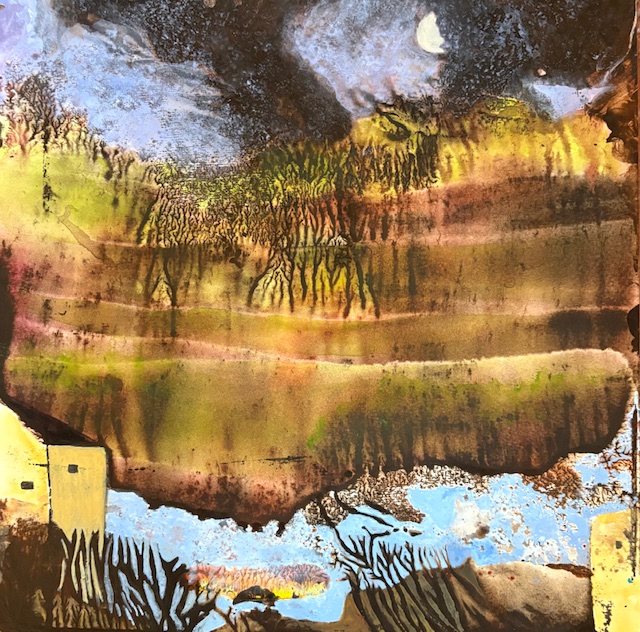
DECALCOMANIA – This is a technique used by Max Ernst and other Surrealists. My method of decalcomania is to apply thick paint on paper, cover it with a sheet of acetate, gently press, then pull the acetate off carefully, creating shapes and textures on the paper. This is my personal Rorschach. I can consider it finished at that point, or paint or draw into it to embellish the images I see.


SPONGE PAINTING – Using a sponge, I randomly fill a sheet with blobs of paint. Again, if I want, I find images in the paint and embellish them.


SCRIBBLE DRAWINGS – I close my eyes and scribble on a sheet of paper until I feel like stopping. I paint or draw into the scribble to further define the images I see.

You can also play using a medium you don’t usually use. For example, anything other than paint if you are a painter. I have a box of magazine scraps I dig into for this purpose. Clay is always a good choice.

Art play can be done in groups. In the past, I hosted “Bad Art Nights” with friends. I piled scraps of paper, magazine scraps, packing material, paint, markers, glitter, fabric scraps, feathers, ribbon, string – anything that can be glued – along with glue and sturdy cardboard for backing on a table. The night’s prize would go to the person making the worst art in the judgement of the group. Someone might be sure they’d be the winner, but disappointed when it was determined that some in the group actually liked what they’d made.

Once when I hadn’t painted for awhile, I wasn’t sure how I wanted to begin again. I told myself I could make 1100 bad paintings before I started making judgements about them. I didn’t get anywhere near 1100 paintings before I got into the flow of working again.

When I’m playing, I’m not trying to create something that could end up in my portfolio. It might end up in the trash. Playing requires letting go of control, suspending judgment and expectations, and being tolerant of making messes.

However, sometimes the images that emerge while playing surprise me. They unexpectedly open new ways of seeing, trigger new ideas, and infuse old ideas with new energy. Occasionally, they end up being saved and even incorporated in a new painting.

What some people call an artist block, I call play time.


For Me, Making Art is a Waking Dream

At times, it seems new ideas simply pop into my mind. This often happens when I’m beginning a new work. I start with a vague idea, and as I work, that vague idea becomes clearer or changes into something else altogether. It feels as if new images magically appear, rather than coming from me.

Lately, I’ve put UFOs into some of my paintings. I think they represent this mysterious process. It makes me wonder about how so many people see them these days. Is there a larger mystery trying to break through into our consciousness?

For years I’ve kept an illustrated dream journal. I’m in awe of the strange vignettes that seem real until I wake up. Scientists say dreams are amalgams of things we’ve experienced during the day. Psychologists say they may be unexplored areas of our psyches. But could they occasionally be something else? Some dreams have an otherworldly feeling. I rarely use a dream image directly in my finished work, however engaging with them and the questions that arise inform my art.

Like the Surrealists, I enjoy using automatism techniques to inspire ideas. They attempt to create something without conscious thought to engage the unconscious. Sunday night is family dinner at my house, and often we play a poetry game that I discovered in Poetry Crazy: Freeing Your Life With Words by Susan G. Wooldridge. Once I had a job that had a lot of down time, so I could browse through magazines and cut out intriguing words. I collected quite a few. When my family plays this game, each person draws eight words out of a box without looking. We arrange our words to create a poem, then read them aloud with interesting and often humorous results.  Before bedtime, I sometimes create and illustrate a poem this way to give my dreaming self an entry to novel thinking.

Scribble drawings and spontaneous drawing are other automatism techniques I like. A Book of Surrealist Games by Alastair Brotchie contains techniques created by Surrealists. Playing these games is like stretching before running a marathon to get the creative juices flowing. Some Surrealists considered the product of these activities to be their art, while others used them as a starting point or inspiration for finished art. For me, they are a way to let the seeds of new ideas emerge. Some get planted and watered and grow into new work.

Sometimes images arise in a crack in the sidewalk, a stain on the floor, or the twisted loops of my bathmat like a waking dream. Where do they come from? Are they merely the soup of my everyday life, or a gift from another realm?

It’s a mystery worth exploring.


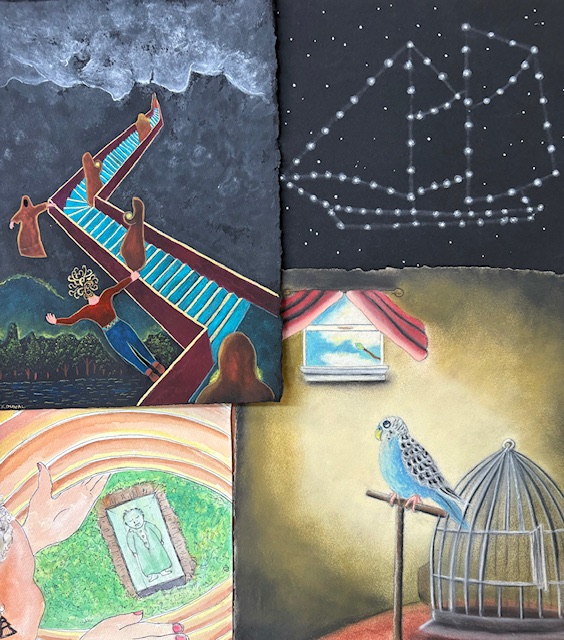
From dream journal sketches


Welcome!

Check this space for news!